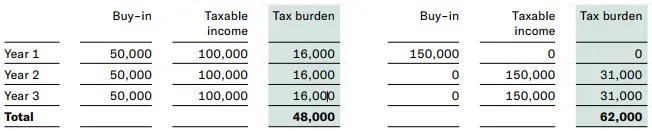
You can get even more out of this by staggering these correctly. If you spread the purchase out over several years, you break the tax progression year after year and ultimately save more than you would with a single large contribution. Note that after a buy-in, there is a 3-year lock-in period for lump-sum withdrawals. If you plan your last purchase at an opportune time, you can easily work around this period.
It’s not worth buying into your pension fund until shortly before retirement.
MISCONCEPTION
Example calculation: If you can contribute a total of 150,000 Swiss francs and have an income of 150,000 (before buying in), you will do much better if you pay in 50,000 three times instead of 150,000 once.
What you need to know about pension fund buy-ins
After financing a home purchase, you must repay the advance withdrawal from the pension fund before you can buy in again.
After a divorce, a gap will arise because the retirement account saved during the marriage will be divided equally. This gap must be topped up before making any ordinary buy-ins. There is no lock-in period for divorce buy-ins.
Every lump-sum withdrawal is subject to the three-year lock-in period: After a buy-in, no capital may be withdrawn for three years, otherwise the tax benefit will lapse retroactively.
After a buy-in, no lump-sum withdrawals can be made from other pension funds or vested benefits foundations either.
There is no lock-in period for ordinary buy-ins where the full pension is drawn.