Retirement provision
The Swiss pension system is based on three pillars. These pillars – the state pension, occupational pensions and private pensions – are intended to ensure financial self-determination and security in retirement. But how exactly does retirement provision work, and what’s behind the three different pillars? We give you an overview below along with some valuable tips.
Switzerland has an advanced social security system. Social security schemes provide a comprehensive support net for the population. Together with supplementary benefits and social assistance, they prevent financial hardship and poverty.
Retirement provision is the most important part of this social security system. The aim of this provision is straightforward: when employment income ceases in retirement, it ensures that we can continue our lives without hardship and with financial independence.
However, the structure of the pension system and how it functions is a little more complex. It consists of three separate pillars that have differing aims, are financed in different ways and are managed by different institutions.
Anyone who knows and understands the basics of the Swiss pension system can plan retirement better and look forward to this stage of their life with greater peace of mind. The focus here will be on the first pillar (AHV/AVS) and the second pillar (occupational pensions). The third pillar, voluntary provision, will also be discussed briefly. This structure is the basis for our tried-and-tested pension system, which is intended to enable everyone to live with dignity in retirement.
Why do we need to provide for retirement?
Our earning capacity declines as we get older, but we still have to meet everyday living expenses. In the past, families provided for older relatives, but in modern society, individual provision is essential. Without financial support, there is a risk of old-age poverty. Switzerland’s three-pillar principle – consisting of federal retirement and survivors’ insurance (AHV/AVS), occupational and private pension provision – ensures that you can maintain your standard of living in retirement. Those who plan early benefit from tax advantages and an optimised investment strategy. PensExpert offers tailor-made solutions for your financial security in retirement.
Benefits of retirement provision
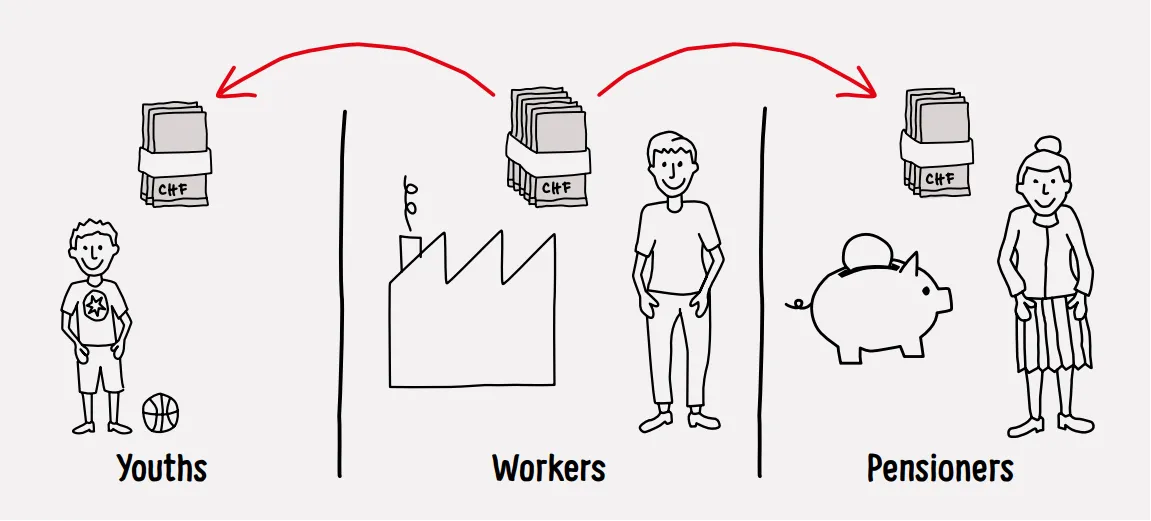
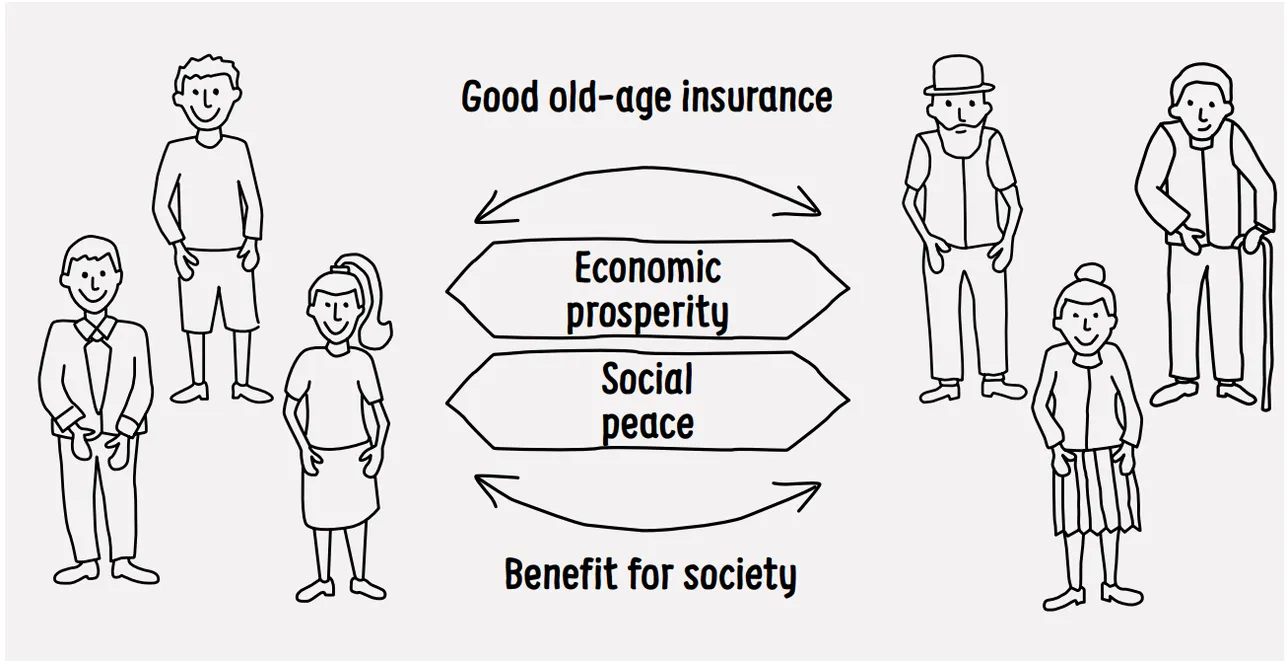
Providing for retirement as a society benefits everyone. It provides security, creates a more equal society and contributes to social stability and economic prosperity.
Retirement provision gives us the security that we can enjoy life in retirement without fear of economic hardship.
We don’t know in advance how long we will live and how much money we will need in retirement. Providing for retirement as a society eliminates this uncertainty and makes it easier to plan for the time after retirement, as no-one has to worry about putting too little aside.
Thanks to the pension system, being able to spend our later years independently and without financial hardship is no longer just the privilege of those who can afford it. The pension system thus makes for a more equal society. There is also support in retirement for those who devote themselves to raising children and caring for others. This support is important for fairness and social stability. Together with the cooperation between the social partners, this lays the foundation for good industrial relations. For decades, this has contributed to the steady growth of prosperity in Switzerland.
Retirement provision enables older people to take part in social and political life and remain integrated in society. This strengthens social cohesion, especially in an increasingly individualised world.
Retirement provision gives senior citizens a secure income and thus ensures that the purchasing power of this important sector of the population is maintained. This benefits the entire economy.
The three pillar system
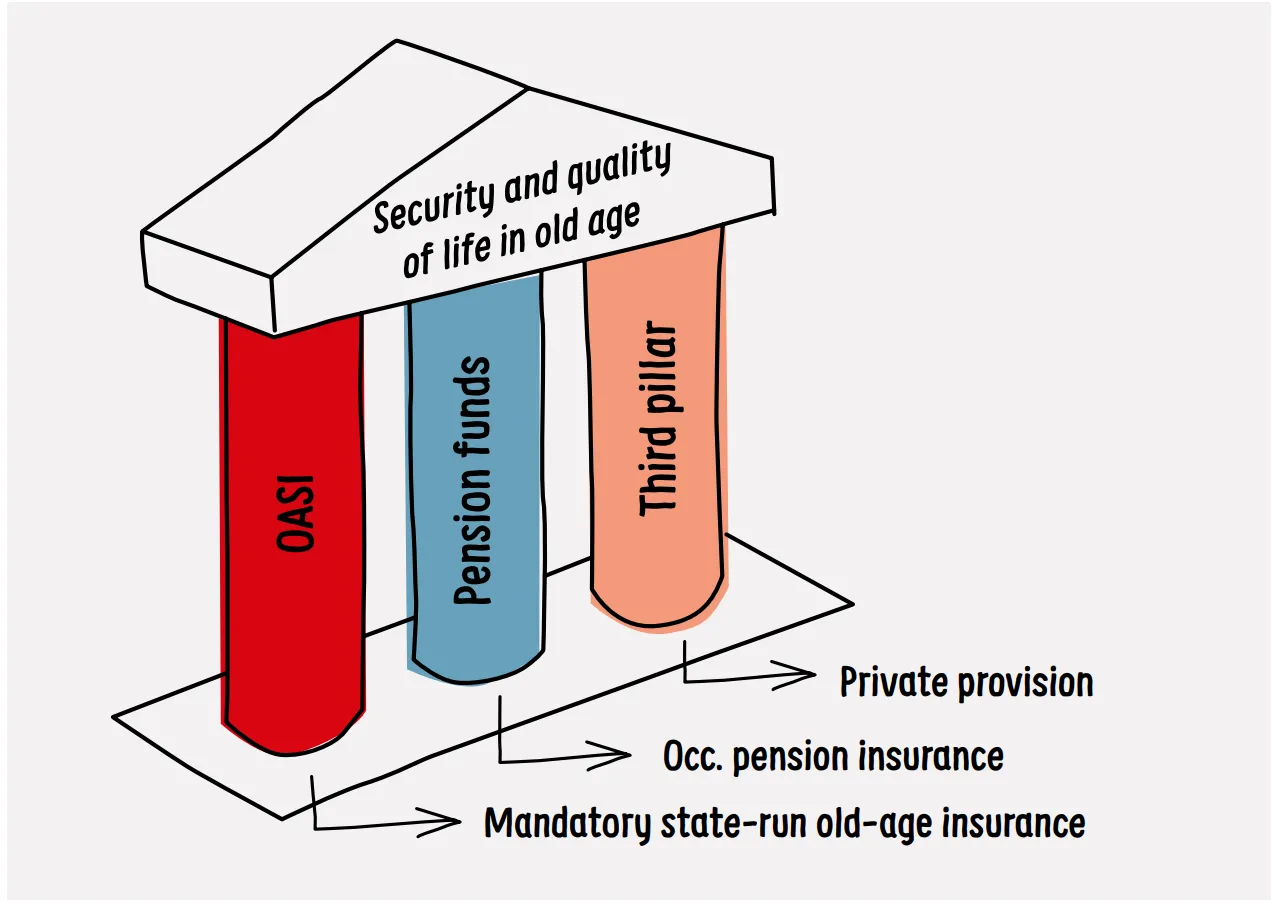
The Swiss three pillar system enables retirement provision to be aligned with the needs of the different sectors of the population and the financing risks to be distributed in the best possible way.
Swiss retirement provision is based on the three pillars of the state pension, occupational pensions and private pension provision. The three pillars have different aims and rules.
The first pillar serves to secure a minimum livelihood and consists of AHV/AVS, Federal Disability Insurance (IV/AI), supplementary benefits (EL), loss of earnings compensation (EO) and unemployment insurance (UI). It is financed as a pay-as-you-go system by contributions from employees and employers as well as from government funds.
Who has to pay into the AHV/AVS?
All employed persons aged 17 and over and inactive persons aged 20 and over pay into the federal AHV/AVS insurance. The contributions amount to 8.7% of salary (4.35% each from employers and employees). The self-employed pay between 4.35% and 8.1%.
AHV/AVS benefits
- Retirement pension: Paid from retirement age (64 and 3 months for women (as of 2026), 65 for men), earlier payment with a deduction or later payment with a supplement are possible
- Survivors’ pension: For surviving spouses and orphans
- Helplessness allowance: For people with everyday disabilities
The second pillar supplements the federal retirement and survivors’ insurance (AHV/AVS) and secures the accustomed standard of living in retirement, in the event of disability or for survivors. It is governed by the Federal Law on Occupational Retirement, Survivors’ and Disability Pension Plans (BVG/LPP) and is mandatory for employees with an annual salary above the BVG/LPP minimum threshold. Self-employed people can join voluntarily. Employers and employees jointly finance the contributions and they are administered by pension funds.
Pension fund benefits
- Retirement benefits: can be taken as a lifelong pension, one-off lump-sum payment or a combination of the two
- Disability benefits: In the event of permanent incapacity for work, the pension fund pays a disability pension based on the previous contribution history
- Survivors’ benefits: Surviving spouse’s and orphan’s pensions are paid out in accordance with statutory requirements
Financing the second pillar
The second pillar is financed by contributions that are invested safely with the aim of earning capital returns. Pension funds are supervised by cantonal authorities and the Swiss Financial Market Supervisory Authority FINMA. In addition to the mandatory occupational pension, extra-mandatory benefits can be added to increase individual coverage.
The third pillar of the Swiss pension system is designed to allow individuals to supplement the first and second pillars. It helps to close pension gaps and secure the accustomed standard of living in retirement, in the event of disability or for survivors. The third pillar is subdivided into tied pension schemes (pillar 3a) and voluntary pension schemes (pillar 3b).
Pillar 3a: Tax-advantaged provision
Pillar 3a allows tax-advantaged contributions that can be deducted from taxable income. The contributions go into bank accounts or insurance solutions and the capital is normally tied up until retirement. Under certain conditions, such as the purchase of a home or early retirement, an early withdrawal may take place.
Pillar 3b: Flexible retirement provision
Pillar 3b comprises freely available forms of savings and investment such as custodian accounts, real estate and life insurance. It offers more flexibility than pillar 3a, but without any tax breaks.
Importance and future of the third pillar
Pillar 3a remains an important element of the pension system, but faces challenges such as demographic change and economic uncertainties. Reforms, technological developments and increased flexibility could further increase the attractiveness of the third pillar. Educating the public about pensions is critical to ensure comprehensive and sustained provision for retirement.
Interplay of the three pillars
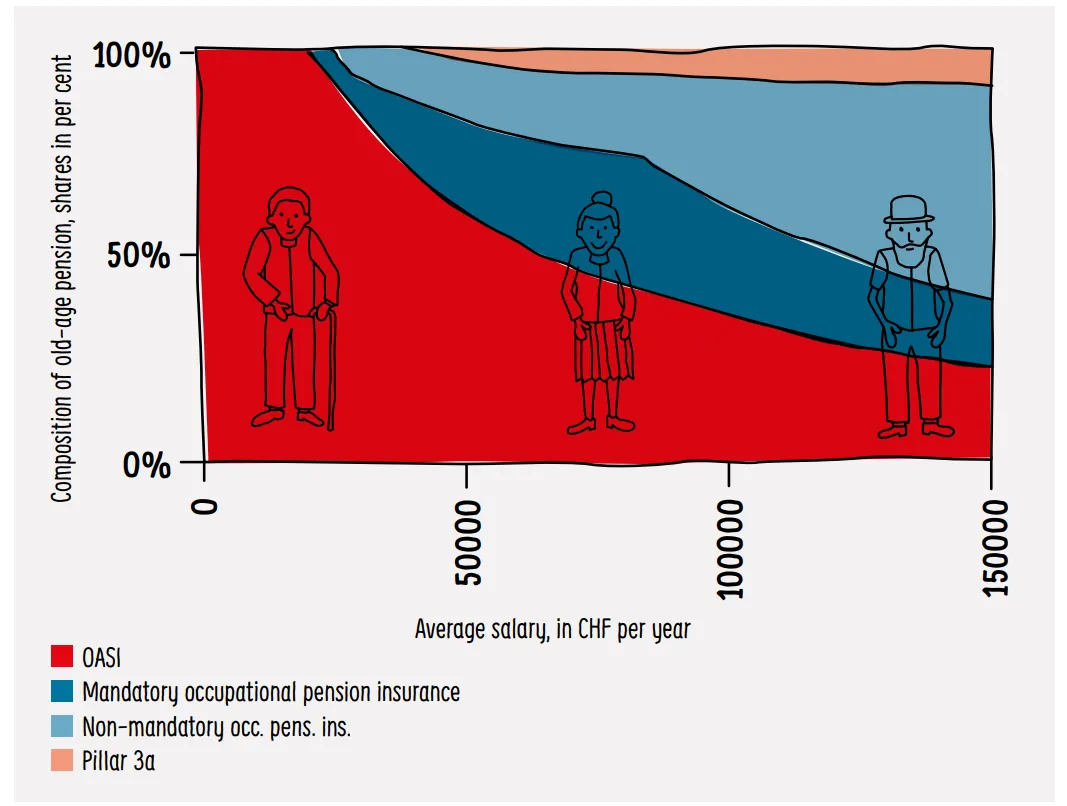
The three pillars of the Swiss pension system build on each other. Their objectives and benefits co-ordinate with one another. AHV/AVS is the basis for retirement provision for the entire population. It covers basic needs – if necessary along with supplementary benefits (EL). This means more than just the minimum for survival. Basic needs means the income that enables you to live simply but with dignity in retirement. This includes maintaining social contacts and fulfilling cultural needs, but also being able to stay in your familiar surroundings for as long as possible.
The occupational pension builds on AHV/AVS. It is intended to enable working people to maintain their previous standard of living in a reasonable way. The benefits of AHV/AVS and the mandatory occupational pension are intended to cover around 60% of the income earned before retirement. As the mandatory occupational pension covers incomes up to around CHF 90'000.–, the target for the two mandatory pension schemes is thus a maximum pension of around CHF 54'000.– annually. Today most members of a pension fund also have extra-mandatory provision, which often enables significantly higher pension benefits.
In addition to the AHV/AVS and occupational pension, employed and self-employed persons can voluntarily build up a third pillar. Assuming they have a second pillar, they can pay in up to CHF 7'258.– on a tax-deductible basis. Those who are not members of a pension fund (which includes not just the self-employed) can pay 20% of their AHV/AVS contributory salary into pillar 3a up to a maximum of CHF 36'288.–.
Composition of the retirement pension