


The system of mandatory occupational pension provision is straightforward: from an annual AHV salary of CHF 22,680 (as of 2026), all employees must be insured under occupational pension schemes. The so-called coordination deduction, currently amounting to CHF 26,460, is deducted from the annual salary. The result is the insured salary, which forms the basis for calculating benefits such as retirement savings contributions and risk benefits.
If a person has two employers and therefore two pension fund affiliations, both pension schemes may apply the full coordination deduction. This leads to a double reduction of the insured salary and consequently to significantly lower pension benefits. The two tabular examples below clearly illustrate the negative impact of having two employers.
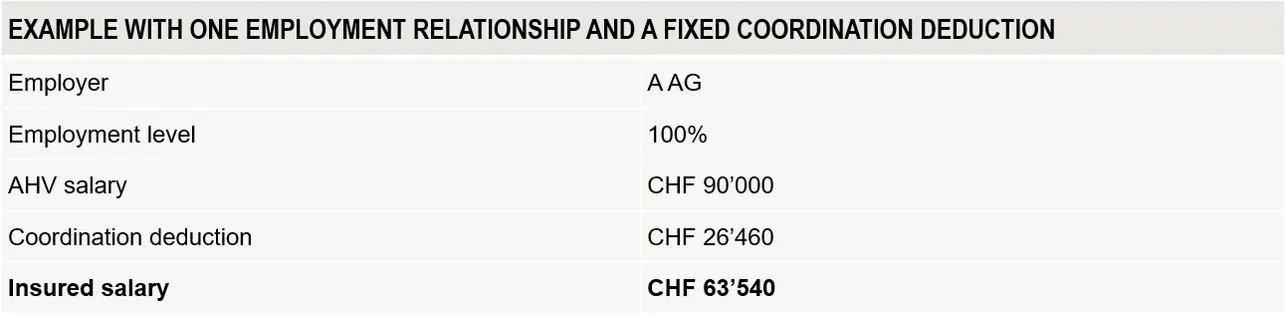
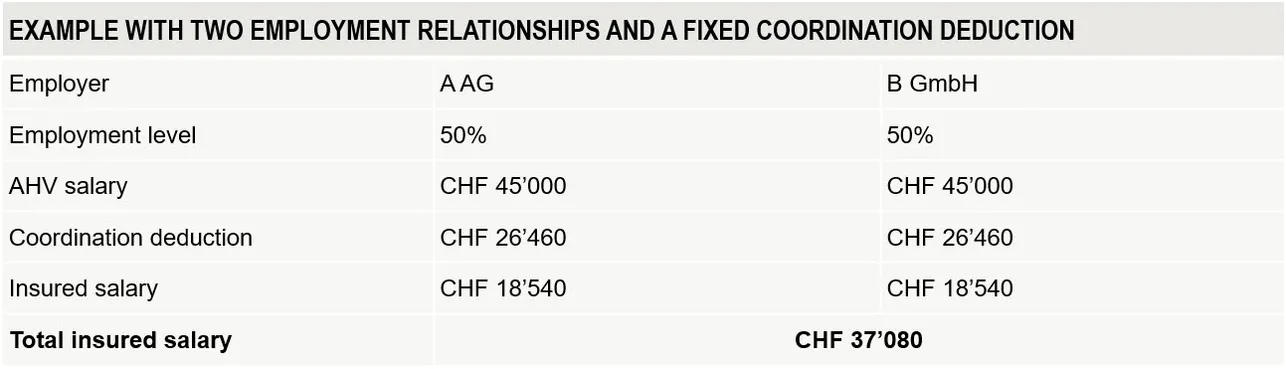
Although the effective AHV salary is identical in both examples, the person with only one employer is significantly better insured, as the coordination deduction is applied only once instead of twice.
The situation is different when employers decide to adjust the coordination deduction according to the employment level in order to provide better second-pillar coverage for part-time employees.
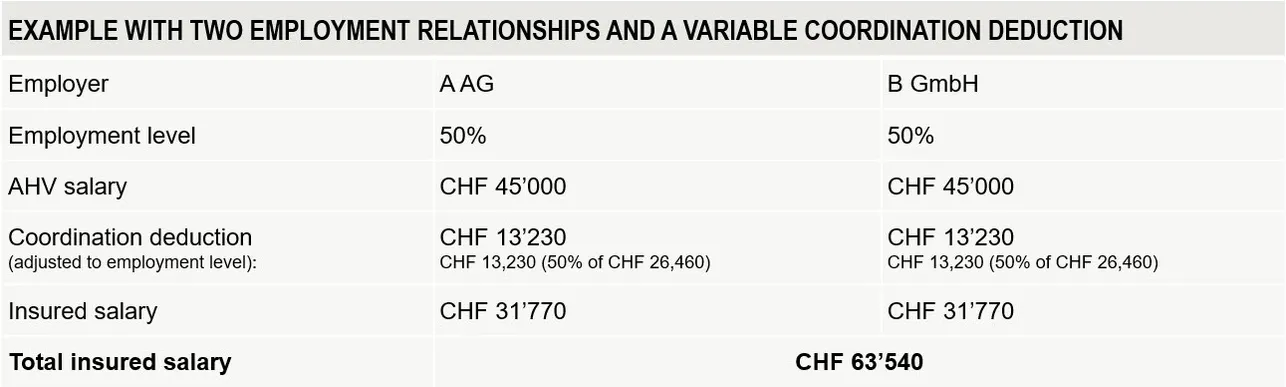
Small Adjustment – Big Impact
Many employers have already recognised the issue of the fixed coordination deduction and have adapted their pension schemes accordingly, enabling employees with multiple jobs and part-time workers to benefit from improved pension coverage.
Employees with progressive pension fund solutions not only accumulate higher retirement assets during their working lives but also benefit from better risk coverage should the worst-case scenario (disability or death) occur.
I can’t choose my pension fund myself
We often hear this statement when discussing pension solutions. While this is partly true, it is by no means prohibited to proactively draw an employer’s attention to potential improvements that benefit all employees. Taking initiative can therefore be worthwhile.
Incidentally, acceptance of the most recent BVG reform in 2024 would have led to more favourable insurance conditions for employees with multiple jobs, particularly regarding the entry threshold and the coordination deduction. As is well known, the reform was rejected by the electorate.
Fortunately, employers do not need to wait for the next reform. They can already improve pension coverage for part-time employees and those with multiple employments today—independently and without unnecessary complexity—and set a positive example. Employees will reward this commitment with loyalty.